Running OpenClaw as a Local AI Agent
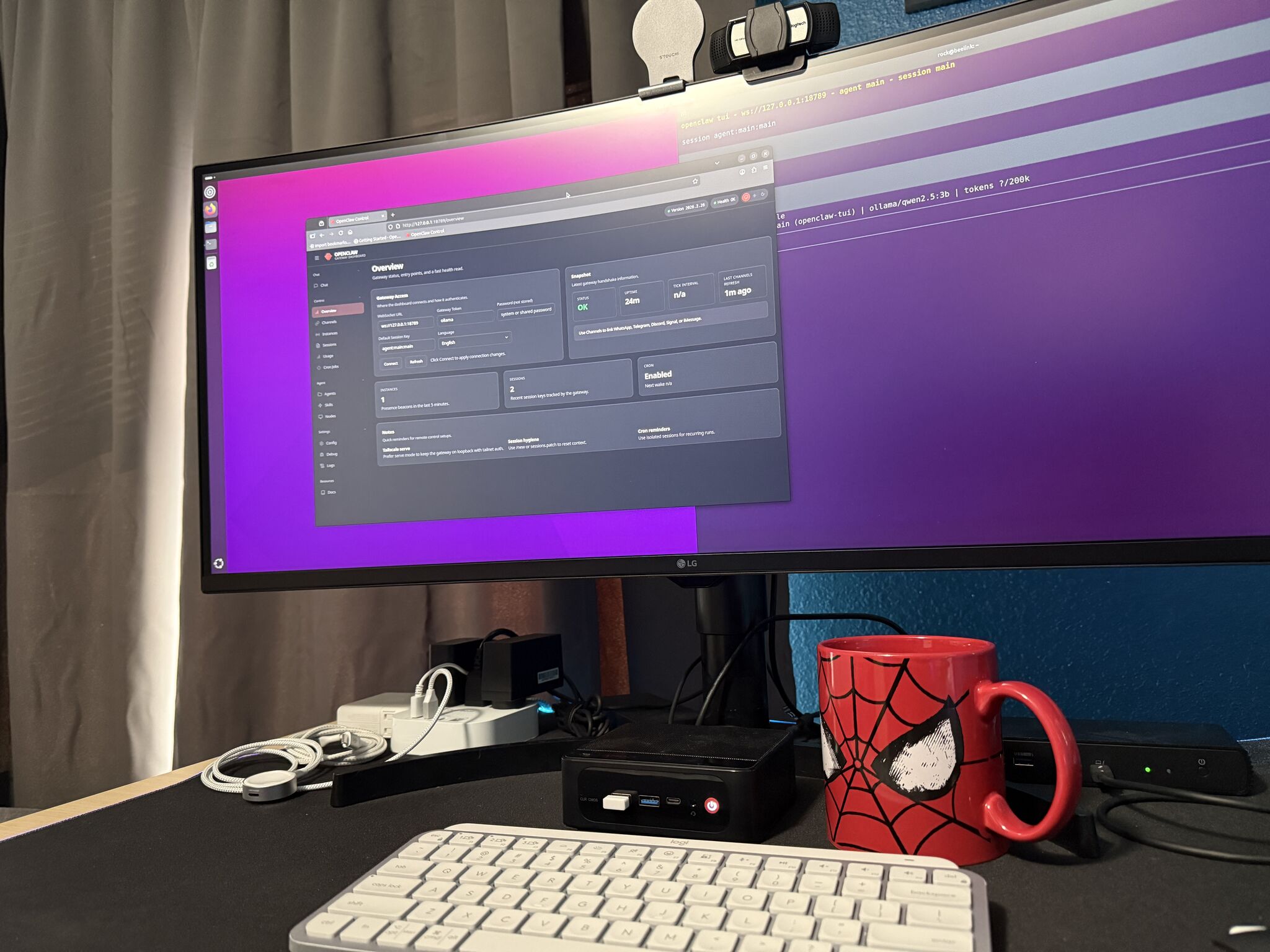
For the past few weeks I’ve been experimenting with running my own local AI agent instead of relying on cloud APIs. This week I finally got OpenClaw working on a small Beelink mini PC, and it feels like an important milestone.
The system is running Ubuntu LTS 24.04, fully updated, and isolated on its own wireless guest network completely separate from my primary LAN. I hardened it further by binding services to localhost, restricting network exposure, limiting filesystem access to a controlled workspace, and running the agent inside a sandboxed container. The goal is simple: strong isolation, minimal attack surface, and full local control.
What makes this setup different is that it’s not using OpenAI, Anthropic, or Gemini APIs. It’s running entirely local using Ollama with the qwen2.5:3b model. This is a relatively small model, so it’s not as capable as larger cloud-hosted models accessed via API tokens. But it’s completely free to experiment with, which was the primary goal. For business or enterprise use, you could run larger models on more capable hardware or integrate API access to significantly increase capability.
Right now I can send it a DM in Discord and it responds directly from my own hardware. More importantly, there’s a key difference between a normal chat interface and an agent platform like OpenClaw. A typical LLM chat responds only when you manually ask it something. OpenClaw provides a framework where the model can be connected to tools, inputs, and conditions, enabling automation and workflows beyond simple questions and answers.
It took longer than expected to get everything working, mostly because my budget and resources are limited. I’m working with a small Beelink mini PC and essentially zero budget. If I had enterprise hardware or significant funding behind it, the setup and capabilities would be very different. But part of the value here is proving what’s possible with minimal resources and fully open tooling.
Now that it’s up and running, the focus shifts to exploring what it can actually do and whether there is practical value in running an isolated, local AI agent like this.